
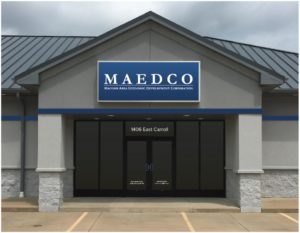
MAEDCO is a not-for-profit, public corporation providing a full range of services to help meet growing business’ needs in the city. We provide a storehouse of information designed to help your business develop and expand. MAEDCO provides a variety of services including attraction, expansion, and retention to the business community of Macomb. In addition, MAEDCO provides direct professional and technical assistance to large and small businesses in McDonough County.
For its residents, the city of Macomb and its numerous municipalities offer ample opportunities to live, work, and play. Macomb offers endless entertainment and recreational opportunities within the city. The community provides an excellent education system with both Western Illinois University and Spoon River College as part of the community. Macomb offers a competitive business environment and growing workforce – with a new manufacturing expansion underway today.
Whether its new business development or expanding business and industry it’s made easy when working with the Macomb Area Economic Development Corporation. This website is designed to be a useful tool for everyone with up-to-date economic development news and information.
WHAT IS ECONOMIC DEVELOPMENT?
Economic development is the intentional practice of improving a community’s economic well-being and quality of life. It includes a broad-range of activities to attract, create, and retain jobs, and to foster a resilient, pro-growth tax base and an inclusive economy. The practice of economic development comprises of a collaborative effort involving industry, government and myriad community stakeholders.
WHAT IS AN ECONOMIC DEVELOPMENT ORGANIZATION (EDO)?
Economic developers often work within an organization solely purposed to support economic development, referred to as economic development organizations (EDOs). Communities may have one or more EDOs as independent organizations or part of a government entity, a public- private partnership, a chamber of commerce, a non-profit, or non-governmental organization. Some community organizations, such as utilities, corporations or higher-education institutions, may also have offices or divisions within them tasked with supporting economic development.
SERVICES WE OFFER
BUSINESS RETENTION & EXPANSION (BR&E)
Business retention and expansion (BR&E) is a core component of economic development. BR&E programs help existing businesses survive economic difficulties and assist with expansions that create new jobs. This area consists of assessing the physical, geographical, financial, technological, and human resource needs of companies within the community. “Early warning systems” are established so that action can be taken to help at-risk companies overcome challenges that could lead to layoffs, shutdowns, or relocation.
ENTREPRENEUR & SMALL BUSINESS DEVELOPMENT
Supporting small businesses and entrepreneurs is one of the core functions of economic development. Whether it is providing access to capital, incubator space to develop the next big thing, technical assistance to navigate regulatory processes, or support for entering a new market overseas, economic developers are ‘all in’ when it comes to entrepreneurs and small businesses.
MARKETING & ATTRACTION
Economic developers develop and execute marketing & attraction strategies and campaigns to market their community to existing and potential businesses. The right marketing strategy can promote a community’s unique qualities, programs, and resources, and target a particular industry sector or audience, strengthening a community’s economic well-being.
STRATEGIC PLANNING
Economic developers are involved in the development and execution of a community or region’s strategic plan. The strategic plan provides a path toward economic success and well-being and incorporates several key stakeholders. The role of an economic developer as a convener is perhaps no more critical than in the context of a community’s strategic plan.
WORKFORCE DEVELOPMENT
Economic developers work in concert with workforce development agencies to support a robust, resilient talent pool for existing and future businesses in their community. This includes engaging with businesses to know their current and future talent demands, working with educational institutions to translate that into training programs, and partnering with workforce development agencies to develop policies that support businesses and workers alike.
REAL ESTATE DEVELOPMENT
Economic developers are frequently engaged in major real estate development projects, particularly industrial parks, incubators, brownfields redevelopment, and sometimes housing. Although the vast majority of real estate development projects are a response to market forces, economic developers’ engagement is crucial where public sector support is the only way to ensure equitable development projects in a community. Development projects are integrated with the economic development plan for the community.